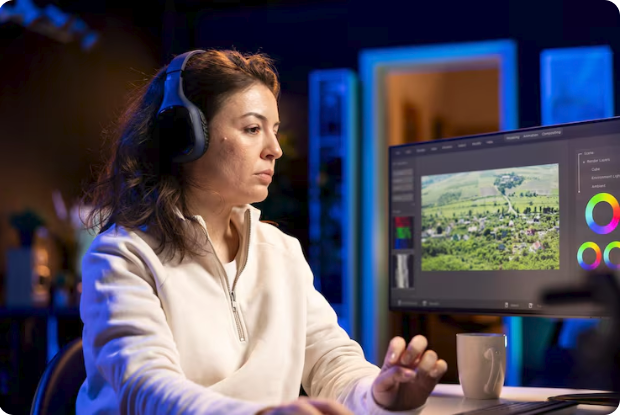

The photo editing process has changed a lot over the years, and today this process isn’t just the work of a technologically savvy individual; it’s a common practice done by many consumers in their day-to-day lives. Now with the smartphone, online editors and artificial intelligence, it is more accessible for individuals to make creative alterations and modifications to photographs with what was once advanced software knowledge. Modifying lighting, eliminating unsightly items or altering facial features by modern editing tools is speeding up the process of customizing images.
A very interesting development is having the possibility to alter facial elements without manually drafting or “retouching” each element. AI-based photo editors are able to extrapolate the face from a picture, determine its components like hair, eyebrows, lips, facial outlines and other features, and subsequently make realistic changes on the face, while trying to maintain its appearance. This technology has opened up new opportunities in video games that allow users to play, sample content on social media platforms, practise digital marketing, and experiment with other applications personally.
How Does AI Photo Editing Stand Out?
In the traditional photo-editing world, selections done by hand, brushes, layers and adjustment tools are all that are relied upon. These characteristics offer a lot of control, but may require a learning curve. For a user who wants to make a relatively small change, he or she must learn the masking, blending, colour matching and other aspects of the technical process when designing artwork.
AI editing takes a different perspective of the issue. When an AI system reads an image and acts on a user’s request to edit a specific part of it; it saves users the time of having to work out every pixel, considering the entire image only requires overall manipulation. The software can automatically find which objects, which aspects of the face belong to the result and give the appropriate answer.
This isn’t to say, it’s the best editing done by AI. Faces in unusual lighting or complex backgrounds, low quality photos or partially covered faces may still yield inconsistent results. The technology is continually evolving though with the improvement of the image-generation and computer-vision models’ capabilities.
Personalizing Facial Features With AI
One of the most creative of the AI tools is for facial editing. Users can try different hairstyles or even add glasses, make-up, facial hair, expressions and change other visual attributes of the photo without having to change the original image.
For instance, an individual who wishes to generate a comic social media post may possibly consider how they will appear by using a variety of facial hair. An AI-powered editor can create a natural-looking modification instead of having to paint with single hairs, using the person’s face, lighting and present picture attributes to do so.
Drivers could use tools which can help them to add mustache to photo. This changes the look as a temporary measure, so the users can try various looks and even compare them before settling on which way they would like to see it.
The same learning method is applicable to other creative editing. Individuals may try various looks or points of view prior to choosing a true look, such as for a beard, hairstyle, eyeglasses or different apparel.
Why Context Matters – for Realistic Results
AI photo editing isn’t just about putting an additional component in an image. There are many “contexts” to consider when it comes to realistic results.
Some sort of feature on the face must correspond with the lighting direction, skin coloring, photo resolution, face angle and general photo style. For instance, a mustache created on the brilliant picture of the face from the front will have a different appearance than one put on a side-on photo shot outdoors.
Good AI editors then try to gauge the context of the image and come up with a modification. To those who have arrived at the new element, they may observe shadows, contours, facial surfaces, textures and proportions to make the newly created element look natural.
The shallower the photo that the user provides, the better the results will be. An image that is well-lit and shows the person’s face from the front is likely to contain more data that will help the AI model than one that is dark or very blurred.
AI Editing for Social Media and Content Creation
The demand for fast and easily-available image-editing tools has been accelerated by the surge in social media. What’s more, creators often demand fresh content and visuals for their post, thumbnails, ads, profile photos and short-form content. It can be impractical to invest many man-hours in editing each and every image.
Repetitive tasks can be minimised with the help of AI. A creator using AI could try to have multiple iterations of a portrait, to remove any extraneous items from the background, to tweak composition, or even to macerate with varying visual ideas.
A second thing that you can do with facial transformations is add content that is amusing. This is a simple trick that will enable you to pick an apparently random portrait to morph the person into an image that seems to be based on a character or pun, or simply make a visual gibe without having to be a pro at the photo editing software!
But for people whose photos are being used, the creators need to take into account issues of context and consent in the photo manipulation. An innocent personal experiment can become troublesome if one of the images is edited and deemed authentic and distributed without the subject’s permission.
AI Photo Editing and Digital Identity
The difference between original photographs and images “manipulated” using image editing is increasing in significance with the development of more realistic image editing technology.
There are millions of people who tend to edit their own photos of which many of the changes done are harmless. Brightness adjustment, spot removal and changing hairstyles in the photo is considered a normal photo editing. Issues with problems arise when heavily edited images are used, with the purpose of deceiving viewers.
For that reason, a responsible use is starting to be an important area of digital-image culture. Users are not allowed to use any AI edit to try to mask as another user, or to provide evidence which is misleading or comes from misrepresentation.
If the image is being used for recreation, it is also important to make it known that it is altered; this can aid in stopping any confusion. Repurposing the images and sharing them beyond the context of their creation makes transparency especially significant when it comes to AI-generated or AI-altered photos.
Choosing an AI Photo Editor
There are different features that each AI photo editor has. AFu users will have to consider some factors before they choose a tool.
Usability: An intuitive screen is beneficial for users who don’t want to take the time to master a complex application.
Precision – Advanced editing features might help users to edit the generated text, with text prompts, selection controls, or adjustment options.
Image quality: Check out for tool that provides clear images and does not create noticeable distortions in the image.
Privacy – Personal information which can be very sensitive does exist in photographs. Users need to know distinct how images they place on the website will be treated by the editing service (if images are stored or used for training the models, etc.).
Professional or personal: Export functionality options such as file type, resolution, watermarks/export restrictions can determine if an editor is fit for professional or personal use.
The fun and professional editing differences
AI photo editing tools can be used for a variety of purposes. Who use software for shows may just desire to try out how it looks or make entertaining pictures that they can show to their buddies. Professional users, on the other hand, can use AI as one of a range of creative elements.
AI should be seen more as an adjunct and not a substitute for human decisions for professionals. Proportions, composition, realism and visual consistency are all things a designer and a photographer must check out. While AI can expedite some aspects, the final product may require meticulous attention to detail as well.
To the people who use it occasionally, maybe the fastest and fun is all that matters. Iterative testing of an idea within seconds makes it much easier for people to be creative and make experiments.
Looking Ahead
As AI technology evolves, expect more such image editing capabilities to be incorporated into decentralized, user-friendly photo apps in the future. The next set of tools could be more precise, preserve more of the face, increase the lighting and depth capabilities and give a more natural look for the elements that were added.
Perhaps most importantly is the fact that the users will not be as aware of sophisticated editing. People can just tell their computer where they want to get an edit instead of starting up a complex desktop app and manually creating a edit.
Not only is that transformation, but it is a sign of bigger changes with digital creativity. The time-shifted image-editing process is transforming from a technically based process to an idea and instruction based process. From trying out new looks to crafting social media posts to a whole new concept, AI makes it a bit more accessible.
These tools can be used in an appropriate way and enhance experimentation and save on time. The trick is to create a balance between convenience, authenticity, privacy and responsible use – to make sure that tools, which are ever more powerful, edit the way they are expected to and remain a creative help rather than a tool of deception.
Read More : Flexible Tech Solutions: How Laptop Rentals Support Remote Work