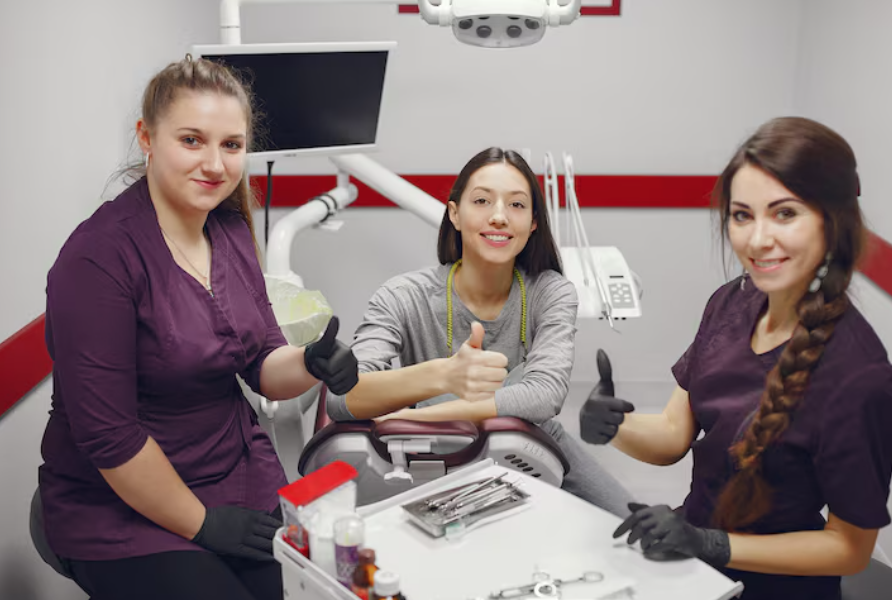

You might be feeling like your mouth has turned into a full-time project. Maybe your general dentist in LA is talking about fillings and cleanings, while the orthodontist is focused on crowding or your bite, and you are left wondering who is really in charge of your smile.end
It can feel scattered. One office looks at cavities, the other looks at crooked teeth, and you are trying to connect the dots between them. You might worry about cost, about how long treatment will take, or whether you are being sent from one specialist to another without a clear plan.
Here is the short version. When your general dentist and orthodontist work together as a team, your care becomes more efficient, safer, and usually more cost effective over time. Your general dentist protects the health of your teeth and gums. Your orthodontist aligns your bite and smile. When those two pieces are planned together, you get a cleaner result, fewer surprises, and better long term oral health.
So where does that leave you when you are already feeling overwhelmed and unsure whom to trust first.
Why does it feel so confusing to see both a general dentist and an orthodontist?
Think about what usually happens. You schedule a routine checkup. Your dentist mentions crowding, wear on certain teeth, or jaw pain. Maybe you have already noticed that your teeth are shifting, or that your child’s teeth are coming in at odd angles. Then you hear the word “orthodontist” and suddenly it feels like a whole new world of appointments, costs, and choices has opened up.
The stress is real. Many adults already feel behind on dental care. According to public health data, adults with poor oral health are more likely to report fair or poor general health overall, and more activity limitations in daily life. You can see this connection in data shared by the CDC on oral health and overall health. So when someone suggests adding orthodontic treatment on top of everything else, it can feel like too much.
Because of this tension, you might wonder if you really need both. Maybe you think, “If I straighten my teeth, they will be easier to clean, so I will just do orthodontics and worry about the rest later.” Or the opposite. “I will fix the cavities and skip braces, it is cheaper and I am too old for all that.”
This is where the difference between treating symptoms and treating causes becomes important. Crooked or crowded teeth can trap plaque, make cleaning harder, and increase the risk of gum disease and decay. At the same time, cavities, old fillings, and gum problems can interfere with safe orthodontic movement. You can straighten teeth that are not healthy, but the results will not last as well, and you may end up needing more treatment in the future.
What actually improves when general and orthodontic dentistry are coordinated?
Think of your mouth as a system. Your general dentist is your primary care provider for that system. Your orthodontist is your specialist for alignment and bite. When they communicate, you benefit in several ways.
First, planning becomes safer. Before orthodontic treatment, your dentist can address active decay, gum inflammation, or infections. That means you are not moving teeth that are already in trouble. Professional guidelines strongly encourage this kind of cooperation. The American Dental Association explains how referrals to specialists are meant to support, not replace, the role of your general dentist.
Second, timing improves. For children and teens, your general dentist often spots early signs that the jaws or teeth are not developing in a balanced way. A timely referral to an orthodontist can shorten treatment or even prevent more complex problems. For adults, your dentist may coordinate orthodontic treatment with restorative work like crowns or implants, planning where each tooth needs to end up before permanent work is done.
Third, results last longer. Straight teeth are generally easier to clean. That means better control of plaque and bacteria, which supports your gums and overall health. Research has shown that periodontal health can improve when orthodontic treatment is combined with good hygiene and regular care. For example, a study on adult patients found that orthodontic treatment, when paired with periodontal therapy, led to better long term stability and health of the supporting tissues. You can see work in this area in research indexed on PubMed.
So the question becomes, not “Do I choose one or the other,” but “How can my general dentist and orthodontist plan this together so I am not repeating work or wasting money.”
How does teamed care compare to “one at a time” treatment?
To make this easier to picture, it helps to compare what happens when your general dentist and orthodontist coordinate versus when they work in isolation.
| Aspect of care | Teamed general dentist and orthodontist | “One at a time” or isolated care |
|---|---|---|
| Treatment planning | Shared plan that covers health, function, and appearance together | Separate plans that may conflict or require rework |
| Oral health during treatment | General dentist monitors gums, cavities, and hygiene while teeth move | Higher risk of decay or gum issues going unnoticed during orthodontics |
| Cost over time | Fewer surprises, less need to redo fillings, crowns, or cosmetic work | Possible extra costs to replace work that no longer fits after tooth movement |
| Comfort and function | Bite alignment planned with existing restorations and jaw comfort in mind | Improved appearance, but bite or jaw strain may persist |
| Long term stability | Straight teeth supported by healthy gums and strong restorations | Straight teeth, but higher risk of future breakdown without strong foundations |
When you see it side by side, it becomes clearer why general and orthodontic dentistry working together tends to feel smoother for you. It is less about adding more providers and more about getting them to speak to each other so you are not stuck in the middle translating.
What can you do right now to get your dentist and orthodontist on the same page?
You do not need to manage every clinical detail. You simply need to set the expectation that your providers will coordinate. A well run general dentist and orthodontist team will welcome that.
1. Start with a full checkup before or during orthodontic planning
If you are considering braces or clear aligners, schedule a thorough exam and cleaning with your general dentist first, or at least early in the process. Ask for an honest update on cavities, gum health, and any old dental work that might be affected by tooth movement.
You can say something as simple as, “I am thinking about orthodontic treatment. Is there anything we should fix or stabilize before my teeth start moving.” This invites your dentist to think ahead and to coordinate with the orthodontist.
2. Give permission for your providers to share information
Dental and orthodontic offices often hesitate to share detailed records unless you clearly approve it. At your appointments, ask that your x rays, photos, and treatment notes be shared between your general dentist and orthodontist.
Use plain words. “I would like my dentist and orthodontist to coordinate my care. Please send them a copy of my records and feel free to speak directly with each other about my plan.” That one request can prevent misunderstandings and repeated work.
3. Ask for a simple, written plan that connects both sides of care
You do not need a technical report. You do need a short outline that covers the order of treatment and who is doing what. Ask for something like this.
- What needs to be done by my general dentist before orthodontic treatment starts.
- How often my general dentist wants to see me during orthodontic treatment.
- Any restorative or cosmetic work that is planned after the teeth are aligned.
Having this in writing helps you budget, plan time off work or school, and feel less in the dark. It also keeps both providers accountable to the same roadmap.
Bringing it all together so your smile and health both benefit
You do not have to choose between healthy teeth and a straight smile. When general and orthodontic dentistry work better together, you get both. Your dentist keeps your teeth and gums stable. Your orthodontist brings your bite and smile into balance. Together, they protect your investment and your comfort.
If you are feeling pulled between opinions right now, that is a sign to pause and ask for coordination, not a sign that you are doing anything wrong. You are allowed to ask questions. You are allowed to say you are confused. You are allowed to expect your providers to work as a team.
The next step is simple. At your upcoming visit, ask your general dentist how they plan to work with any orthodontist involved in your care. Ask your orthodontist the same question from their side. One clear conversation can turn a stressful, scattered process into a plan that finally makes sense.